

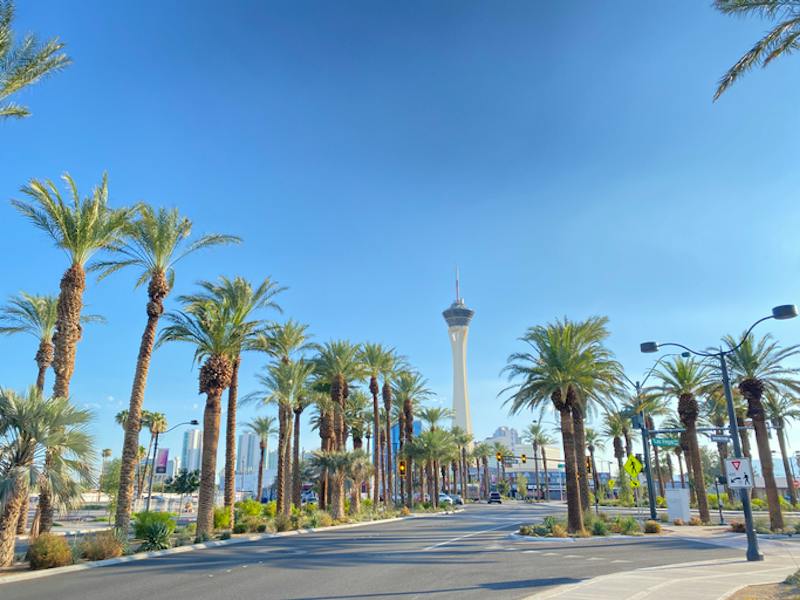
The most dangerous intersections in Las Vegas are the ones the Las Vegas Metropolitan Police Department (LVMPD) ranks highest for crashes each month, including locations along Tropicana Avenue, Decatur Boulevard, Flamingo Road, and Charleston Boulevard. These lists measure how many crashes occurred, not how severe they were, so they are a starting point rather than a complete safety ranking.
The personal injury lawyers in Las Vegas at Cogburn Davidson see the human side of these statistics. Partner Jamie Cogburn is one of only 19 Nevada attorneys certified in personal injury, served as the 2023 president of the Nevada Justice Association, and is a trustee of Citizens for Justice, which advocates for Nevadans at the state legislature.
What Are the Most Dangerous Intersections in Las Vegas?
The most crash-prone Las Vegas intersections on LVMPD's July 2026 list include Tropicana and Paradise, Tropicana and Koval, Rancho and Washington, and Sahara and Valley View.
LVMPD publishes the five intersections with the most crashes in each of its area commands, rather than a single valley-wide ranking. The table below shows the two area command lists reported by FOX5 on August 17, 2026.
| Area Command | Rank by Crashes | Intersection | Month |
| Bolden | 1 | Rancho and Washington | July 2026 |
| Bolden | 2 | Simmons and Vegas | July 2026 |
| Bolden | 3 | Sahara and Valley View | July 2026 |
| Bolden | 4 | Decatur and Vegas | July 2026 |
| Bolden | 5 | Decatur and Meadows | July 2026 |
| Convention Center | 1 | Tropicana and Paradise | July 2026 |
| Convention Center | 2 | Tropicana and Koval | July 2026 |
| Convention Center | 3 | Tropicana and Las Vegas Boulevard | July 2026 |
| Convention Center | 4 | Flamingo and Las Vegas Boulevard | July 2026 |
| Convention Center | 5 | Harmon and Paradise | July 2026 |
Source: LVMPD top crash intersections for July 2026, as reported by FOX5. The ranked lists reviewed for this article do not include crash counts, so the table shows rank only.
Intersections often repeat from month to month. LVMPD's December 2025 list, as reported by KTNV, highlighted Tropicana and Jones, Charleston and Decatur, and Maryland Parkway and Flamingo, all of which had appeared on earlier lists. The January 2026 list included Charleston and Valley View in the Bolden Area Command.
Three points help in reading these lists:
- They count total crashes, so a minor fender bender and a fatal crash carry equal weight
- They cover crashes within LVMPD's jurisdiction, and freeway crashes are often investigated by the Nevada Highway Patrol instead
- They change monthly, so an intersection's ranking reflects one month of data
Which Las Vegas Roads Have the Most Serious and Fatal Crashes?
Serious and fatal crashes concentrate on a small share of Las Vegas streets. The City of Las Vegas traffic engineer said the city found while developing its Vision Zero plan that 77 percent of traffic fatalities and serious injuries happen on only 11 percent of streets, a set of roads the plan calls the High Injury Network.
The city's own figures show the scale. From 2018 to 2022, the City reported 53,596 crashes, 251 fatalities, and 750 serious injuries within Las Vegas.
LVMPD's recurring lists point to several corridors, including Tropicana Avenue, Decatur Boulevard, Flamingo Road, Charleston Boulevard, and Sahara Avenue.
Because those lists count all crashes, they do not by themselves identify the deadliest roads. Fatality data comes from the Nevada Department of Public Safety and Zero Fatalities Nevada, whose preliminary figures, as reported by 8 News Now, showed 381 traffic deaths statewide in 2025, including 239 in Clark County.
Why Are These Intersections So Dangerous?
Speeding, disregarding traffic signals, and failing to yield are the behaviors LVMPD most often points to at crash-prone intersections.
In January 2026, LVMPD said its top citations included speeding 11 to 20 mph over the limit, disobeying a steady red signal, and driving without a valid license, insurance, or registration. For July 2026 injury crashes, LVMPD listed failure to yield the right of way, failure to maintain a lane, and disregarding a traffic control device as leading contributing factors.
Official sources identify several behaviors and conditions, including:
- Distracted driving, high speeds, and impairment, which the City of Las Vegas lists as drivers of rising crashes
- Failure to obey traffic control devices, also named by the City
- Intersection and roadway construction, which the City cites as a contributing condition
- Speeding nationally, which the National Highway Traffic Safety Administration tied to 11,775 deaths in 2023, or 29 percent of U.S. traffic fatalities
The Most Dangerous Intersections for Pedestrians in Las Vegas
Pedestrian deaths make up a large share of Nevada's traffic fatalities. Preliminary Zero Fatalities Nevada data reported by 8 News Now showed 111 pedestrians killed on Nevada roads in 2025 out of 381 total traffic deaths, or roughly 29 percent.
Three points help explain what is and is not publicly available about pedestrian risk in Las Vegas:
- LVMPD's crash lists count all crash types, so they do not rank intersections by pedestrian risk
- The City of Las Vegas directs residents to its interactive Vision Zero dashboard to review safety progress, and community members can report concerns through the City's SeeClickFix system
- Under NRS 484B.600, a driver who violates the speed rules and is the proximate cause of a collision with a pedestrian or a person riding a bicycle faces an additional penalty
Nevada law also treats collisions with pedestrians seriously, but pedestrians can be assigned a share of fault under the state's comparative negligence statute, so each case turns on its own facts.
Most Dangerous Areas for Tourists: The Strip and Koval Corridors
The resort corridor appears repeatedly on LVMPD's lists. The July 2026 Convention Center Area Command list includes Tropicana and Paradise, Tropicana and Koval, Tropicana and Las Vegas Boulevard, Flamingo and Las Vegas Boulevard, and Harmon and Paradise.
Visitors may be less familiar with local road layouts, heavy pedestrian activity, and signal timing, which can add risk. A tourist injured in a crash may also face a rental car, a rideshare vehicle, and an out-of-state insurance policy, each adding complexity.
Visitors can generally pursue a claim after returning home, but Nevada's two-year filing deadline under NRS 11.190(4)(e) still applies.
What Is Las Vegas Doing to Make These Intersections Safer?
Las Vegas is relying on Vision Zero planning, targeted enforcement, and public crash reporting. The City’s Vision Zero Action Plan sets a goal of eliminating traffic deaths and serious injuries by 2050, and the City’sown progress report includes the following:
- It has completed 50 of the plan’s 97 original action items and has 28 more in progress
- It has secured more than $45 million in funding
- Completed improvements include traffic-calming chicanes, mini roundabouts, and upgraded channelized islands
Enforcement and statewide safety efforts are also part of the response, as shown by these developments:
- LVMPD has said drivers should expect more enforcement, following an increase in 2025
- A Southern Nevada Traffic Task Force has said more enforcement waves are likely at the valley’s most dangerous intersections
- As of August 17, 2026, LVMPD reported 74 traffic fatalities for the year, compared with 103 over the same period in 2025
- Nevada proclaimed October 12 to 18, 2026 as Traffic Safety Week
Whether these efforts reduce crashes at any particular intersection will show up in data over time.
Who Is at Fault in a Crash at a Busy Las Vegas Intersection?
Fault in a Las Vegas intersection crash depends on the evidence, and more than one driver can share it. Under NRS 41.141, an injured person can recover damages if his or her own negligence was not greater than the defendant's, with the award reduced by that person's share of fault.
Fault questions that commonly arise at intersections include:
- Who had the right of way, and whether the signal was red, green, or flashing
- Whether a left-turning driver yielded to oncoming traffic
- Whether a T-bone impact points to a signal or yielding violation
- Whether either driver was speeding or distracted on approach
- What video, vehicle data, and witness accounts show
Evidence from nearby businesses, buses, and dashcams can be overwritten quickly, so identifying it early often matters.
What to Do After a Crash at a Las Vegas Intersection
Prompt steps after an intersection crash can help ensure safety and proper documentation. Nevada sets duties for drivers following a crash in NRS Chapter 484E, according to the Nevada DMV.
- Step 1: Check for injuries, move to safety if possible, and call 911.
- Step 2: Stay at the scene, exchange information, and note which agency responds and the report number.
- Step 3: Photograph vehicles, signals, signs, lane markings, tire marks, and visible injuries.
- Step 4: Look for cameras at nearby businesses and on vehicles, and promptly ask about the footage.
- Step 5: Get a medical evaluation, since some symptoms appear days later.
- Step 6: Be cautious with recorded statements to insurers and with social media posts.
- Step 7: Keep the two-year deadline in mind.
Why Choose Cogburn Davidson After a Las Vegas Intersection Crash?
Intersection cases often turn on competing accounts, signal timing, and vehicle data. Attorney Hunter Davidson, a graduate of the UNLV William S. Boyd School of Law, has tried multiple motor vehicle cases before juries with favorable verdicts. Cogburn Davidson's reported results include a $6.8 million car accident recovery and a $2.4 million truck accident recovery, and the firm prepares every case with the possibility of trial in mind.
Past results do not guarantee a similar outcome in any other case. To discuss a crash, call the Las Vegas office at 2300 W Sahara Ave, Suite 800-816, at (702) 805-3275, available at any hour, to schedule a case evaluation with Cogburn Davidson.
Sources
- LVMPD top crash intersections for July 2026, as reported by FOX5
- LVMPD December 2025 list, as reported by KTNV
- LVMPD January 2026 list, as reported by FOX5
- LVMPD January 2026 citations, as reported by KTNV
- Zero Fatalities Nevada 2025 preliminary data, as reported by 8 News Now
- City of Las Vegas, Vision Zero Action Plan update
- City of Las Vegas, Vision Zero overview
- KSNV, Las Vegas Vision Zero launch
- NHTSA, Speeding: 2023 Data
- FOX5, Southern Nevada Traffic Task Force
- FOX5, Nevada Traffic Safety Week
- Nevada DMV, Traffic Laws and Safety
- Nevada Revised Statutes:NRS 484B.600,NRS 41.141,NRS 11.190
Disclaimer: This article is for informational purposes only and does not constitute legal advice. Every case is different, and the law is extremely nuanced, so each situation must be evaluated individually based on its specific facts.