

Disclaimer: This content is provided for general educational purposes only and does not constitute legal advice. Every case is different. Past results do not guarantee future outcomes.
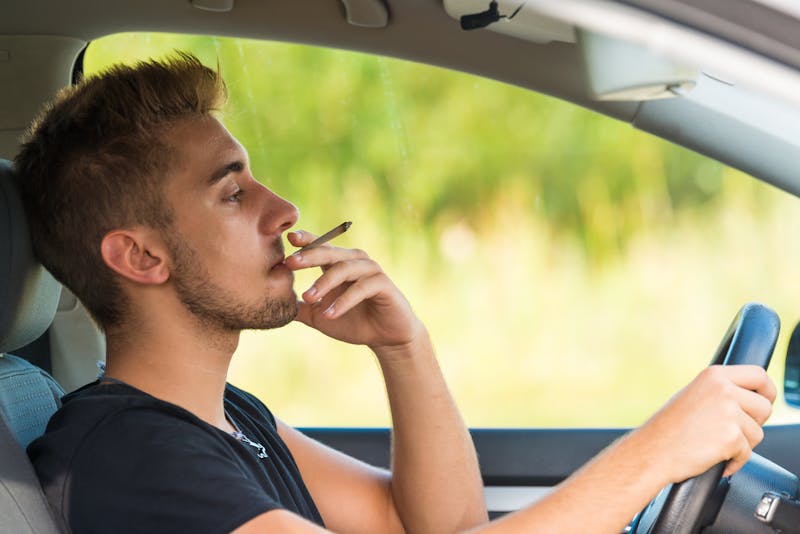
If a driver high on marijuana hit you in Las Vegas or Henderson, you can pursue a personal injury claim against them the same way you would against a drunk driver. Nevada does not treat marijuana impairment as a lesser offense than alcohol impairment, and a driver's cannabis use can support both criminal charges and a civil claim for your medical bills, lost wages, and pain and suffering.
Cogburn Davidson Car Accident & Personal Injury Lawyers has recovered more than $250 million for injured clients across Nevada, and founding partner Jamie Cogburn is one of only 19 attorneys in the state board-certified in personal injury law. Below is what actually happens, legally, after a crash caused by a marijuana-impaired driver.
What Nevada Law Says About Driving High on Marijuana
Nevada defines driving under the influence of marijuana under NRS 484C.110. Marijuana is legal for adults 21 and older to possess, but that has no bearing on whether a person can be charged with DUI for driving while impaired by it.
A recent change reshaped how these cases work:
- Assembly Bill 400 repealed the old "per se" marijuana threshold for first and second DUI offenses
- Before that change, a driver with 2 nanograms per milliliter of THC or 5 nanograms per milliliter of the marijuana metabolite in their blood was automatically guilty, regardless of whether they were actually impaired
- Today, a first or second marijuana DUI requires the prosecution to prove the driver was genuinely impaired at the time of the crash
The old per se rule still applies in one narrow circumstance: a third or subsequent DUI offense within seven years, which is charged as a felony under NRS 484C.400(1)(c). In that scenario, the blood-level thresholds create an automatic violation without a separate showing of impairment.
Here’s what that looks like:
- For the first or second offense, the state must prove actual impairment, not just the presence of THC
- For a third or subsequent offense in seven years, a blood level of 2 ng/ml THC or 5 ng/ml metabolite is enough on its own
- A valid medical marijuana card does not exempt a driver from DUI liability under Nevada law
How Police and Prosecutors Prove Marijuana Impairment
Because most marijuana DUI cases now hinge on impairment rather than a blood-test number, officers rely on a different evidence toolkit than they do for alcohol.
Alcohol impairment is measured against a fixed legal standard: a blood alcohol concentration of 0.08% is unlawful on its own. Marijuana impairment has no comparable bright-line number for most offenses, so officers and prosecutors instead build a case from behavioral and physiological evidence.
That evidence typically includes:
- Standardized field sobriety tests were performed at the scene
- Observations from an officer trained as a Drug Recognition Expert
- Driving behavior observed before and during the stop
- The toxicology report itself, which shows THC was present, even though it cannot pinpoint the level of impairment
A weaker criminal case does not necessarily mean a weaker civil case, since the civil standard for negligence (a preponderance of the evidence) is lower than the criminal standard of proof beyond a reasonable doubt.
Nevada DUI Marijuana Penalties by Offense
| Offense (within 7 years) | Charge Level | Fine Range | Jail/Prison | License Suspension |
| First offense | Misdemeanor | $400 to $1,000 | Up to 6 months | 90 days |
| Second offense | Misdemeanor | $750 to $1,500 | 10 days to 6 months | 1 year |
| Third or subsequent offense | Felony | $2,000 to $5,000 | 1 to 6 years in prison | 3 years |
These figures come from NRS 484C.400, which also allows for ignition interlock requirements and mandatory substance use treatment. Criminal penalties punish the driver; they do not compensate you. Recovering your own losses requires a separate civil claim.
Can You Sue a Driver Who Was High for Your Injuries?
Generally speaking, yes. A marijuana-impaired driver who causes a crash can be held civilly liable for your injuries through a personal injury claim, separate from any criminal DUI case against them.
Under NRS 41.133, a criminal DUI conviction is conclusive evidence of the facts needed to establish civil liability for the related injury.
In practice, that means a plaintiff need not relitigate whether the driver was impaired if the driver has already pleaded guilty to or been convicted of DUI. However, many civil claims proceed and resolve well before any criminal case concludes.
Impaired driving can also support a claim for punitive damages under NRS 42.005. Nevada requires clear and convincing evidence that the defendant acted with one of the following:
- Oppression toward the victim
- Fraud
- Malice, meaning conscious disregard for the safety of others
Driving while impaired is commonly argued to meet this standard on the malice prong. Punitive damages, when awarded, are capped at three times the compensatory damages or $300,000, whichever is greater, for most claims.
What If You Were Partially at Fault?
Nevada follows a modified comparative negligence rule under NRS 41.141. You can still recover compensation even if you share some fault for the crash, as long as your percentage of fault is not greater than the combined fault of the defendants.
Your own percentage of fault reduces your compensation:
- If a jury finds you were 20% responsible and the impaired driver was 80% responsible, your award is reduced by 20%
- If you were found more than 50% at fault, Nevada law bars recovery entirely
This is why an accurate, well-documented account of the crash matters from day one.
Steps to Take After Being Hit by a Suspected Impaired Driver
- Call 911 and request a police response so an official crash report is generated
- Seek medical attention right away, even if you feel fine, since some injuries surface hours or days later
- Note anything you observed about the other driver, such as the smell of marijuana, erratic driving, or slurred speech, without confronting them directly
- Get contact information from any witnesses at the scene before they leave
- Avoid discussing fault or giving a recorded statement to the other driver's insurance company before speaking with an attorney
- Keep every medical bill, repair estimate, and pay stub showing lost income
How to Choose the Right Attorney for This Type of Claim
Marijuana-impaired driving cases carry evidentiary complications that a general practice attorney may not often handle. A few factors are worth weighing before you hire one:
- Experience with impaired-driving claims: Ask how many DUI-related injury cases the attorney has actually resolved, and whether that includes marijuana-specific cases where impairment (not a blood number) was the central issue.
- Fee structure: Most personal injury firms, including Cogburn Davidson, work on contingency, meaning you pay no upfront fee and the firm is paid a percentage of your recovery only if you win.
- Specialization: A firm focused specifically on personal injury, rather than one that handles injury cases alongside several unrelated practice areas, is more likely to have up-to-date knowledge of shifting DUI statutes, such as the AB 400 change described above.
- Trial readiness: Insurance companies negotiate differently with firms that are prepared to take a case to a jury versus firms known for settling quickly. Ask directly what percentage of the firm's cases go to trial.
Why Nevada Trusts Cogburn Davidson
Jamie Cogburn has been named a Super Lawyer every year from 2010 through 2016, carries an AV rating from Martindale-Hubbell, and served as the 2023 President of the Nevada Justice Association, where he has pushed for legislation to make Nevada roads safer.
Hunter Davidson, a graduate of UNLV's Boyd School of Law, has appeared before the Nevada Supreme Court on behalf of injury victims and has secured multiple seven-figure settlements in premises liability and motor vehicle cases.
Both attorneys share the same operating principle: prepare every case as if it will go to trial, since that posture changes how insurance adjusters respond during negotiations.
The firm's 4.9-star rating across more than 500 client reviews reflects that approach in practice. Reviewers consistently point to the same thing: attorneys and paralegals who stay in close contact throughout the case rather than disappearing after the first consultation.
For Nevada families dealing with the aftermath of a crash, that combination of local legal influence and hands-on case management is what keeps clients coming back and referring others.
Frequently Asked Questions
How much does it cost to hire a personal injury lawyer for this type of case?
Cogburn Davidson handles injury claims on a contingency fee basis, so you pay nothing up front and no fee at all unless the firm recovers compensation for you.
How long do I have to file a claim in Nevada?
Nevada's statute of limitations for personal injury claims is generally two years from the date of the crash under NRS 11.190. Waiting too long can permanently bar your claim, so it is worth speaking with an attorney well before that deadline.
Do I need the driver to be convicted of DUI before I can sue them?
No. You can file a civil claim regardless of whether criminal charges are filed or how the criminal case turns out. A conviction can strengthen your civil case under NRS 41.133, but it is not a prerequisite to recovering compensation.
What if the other driver denies being impaired?
Your attorney can build a civil case independent of any criminal admission, using police observations, the toxicology report, witness accounts, and the driver's conduct at the scene. The civil burden of proof is lower than the criminal one.
Does it matter if the driver had a medical marijuana card?
No. A valid medical marijuana card does not shield a driver from DUI liability or from civil responsibility for a crash caused by impairment.
Your Next Step After a Marijuana-Impaired Driving Crash
Nevada's marijuana DUI law has changed in ways that make these cases more nuanced than a simple blood test, but that complexity does not weaken your right to compensation after a crash caused by an impaired driver. Every case depends on its own facts, and the law surrounding drugged driving continues to evolve.
Cogburn Davidson Car Accident & Personal Injury Lawyers offers a free case evaluation to help you understand your options under current Nevada law. Contact the firm's Las Vegas or Henderson office today to learn more.