

Disclaimer: This content is provided for general educational purposes only and does not constitute legal advice. Every case is different, and Nevada food safety law is nuanced. The outcome of any claim depends on the specific facts involved and should be evaluated individually by a qualified attorney.
If you get food poisoning at a Las Vegas buffet or restaurant, you may be able to pursue a claim against the establishment or a supplier under premises liability, negligence, or, in some cases, strict product liability. Recovery generally requires proving that a specific contaminated food item caused your illness, that the business breached a duty of food safety, and that this breach directly caused your symptoms.
Jamie Cogburn, one of just 19 Nevada attorneys certified as a Personal Injury Specialist by the State Bar of Nevada, has helped injured clients throughout Las Vegas and Henderson pursue compensation when someone else's negligence causes serious harm. Below is a look at how these claims work, what evidence matters most, and what a victim can recover.
What Legal Claims Apply to a Las Vegas Food Poisoning Case?
Three legal theories typically apply when someone becomes seriously ill after eating at a Las Vegas restaurant or buffet, and the right one depends on where the contamination occurred and who controlled the food at that point.
Premises liability holds a restaurant or resort responsible when unsafe conditions on its property, such as unsanitary food preparation or storage areas, cause harm to a customer lawfully on the premises.
Negligence applies when a restaurant, caterer, or buffet operator fails to exercise reasonable care in sourcing, storing, preparing, or serving food, and that failure causes injury.
Strict product liability can apply against a food manufacturer, distributor, or supplier when a packaged or prepared food product itself is defective or contaminated, regardless of how careful the seller was.
Nevada has recognized strict liability for defective food products since 1966, when the Nevada Supreme Court held a beverage distributor strictly liable after a customer discovered a decomposed rodent in a bottled drink (Shoshone Coca-Cola Bottling Co. v. Dolinski, 82 Nev. 439 (1966)). That case established that a business placing food or beverage products on the market can be held responsible for injuries caused by the product, regardless of whether the business was negligent.
What Must You Prove to Win a Food Poisoning Claim in Nevada?
Winning a food poisoning claim requires proving three elements, and missing any one of them can defeat an otherwise strong claim:
- Contaminated food source: The specific dish, ingredient, or supplier's product responsible for the illness must be identified with reasonable specificity.
- Breach of duty: The claim must show that the restaurant or supplier breached its duty of care, such as by using improper cooking temperatures, causing cross-contamination, or serving expired ingredients.
- Causation: Often the hardest element to establish, this requires connecting the timeline of symptoms to the specific meal in question rather than another possible source.
How Southern Nevada Health District Records Support a Food Poisoning Claim
Southern Nevada Health District inspection reports document a restaurant's food safety history and can serve as powerful evidence of a pattern of violations. The health district conducts unannounced inspections at least once a year for permitted food establishments in Clark County, and inspection results are searchable through its public restaurant inspection database.
Several types of findings from SNHD's restaurant inspection program are particularly useful to a claim:
- Inspection grades, which reflect an overall score at the time of inspection, can be tracked over time for a decline in food safety performance
- Repeated violations, especially for improper holding temperatures, can suggest an ongoing lapse rather than an isolated incident
- Closure history, including any documented closure for an imminent health hazard, which can support an argument that the restaurant knew or should have known about unsafe conditions
Because health district records reflect only a single snapshot in time, the strongest cases usually pair inspection history with other evidence, such as medical records and witness accounts, rather than relying on inspection reports alone.
Why Buffets Carry a Higher Food Poisoning Risk Than Standard Restaurant Service
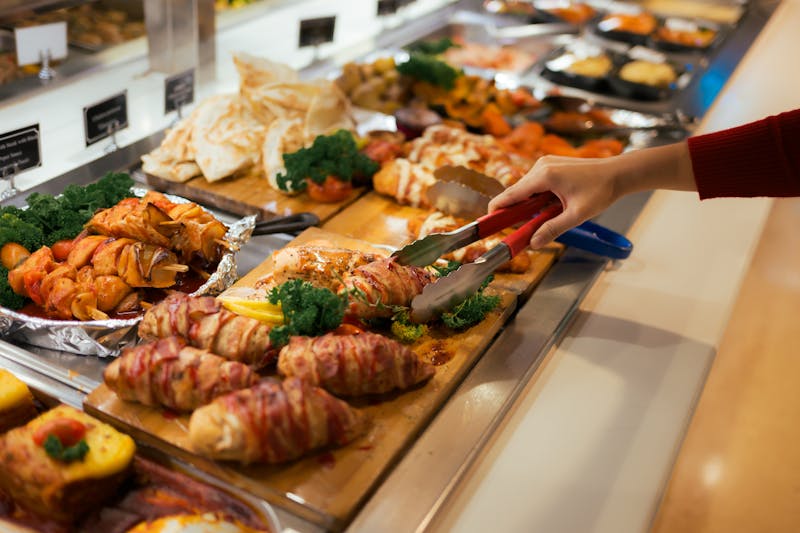
Buffets face distinct food safety challenges that plated restaurant service generally avoids, which is part of why buffet-related illness claims often turn on different facts than a typical restaurant case. For example:
- Food sits out for extended periods under heat lamps or on ice, creating a window for bacteria to multiply if temperatures fall outside the safe zone
- Shared serving utensils moving between dishes increases the risk of cross-contamination between raw and cooked items
- High customer volume, especially during Las Vegas Strip peak tourist seasons, can strain a kitchen's ability to maintain consistent temperature control and refill schedules
- Self-service format makes it harder to track exactly which dish, and which batch of that dish, a specific customer consumed
These factors do not automatically make a buffet operator liable, but they are relevant to establishing breach of the duty of care when combined with health district records and other evidence.
Why Medical Documentation and Stool Culture Testing Matter for Your Claim
Prompt medical care and laboratory testing often determine whether a food poisoning claim succeeds, because they establish the specific pathogen involved and the timeline linking it to a particular meal.
A stool culture can identify the responsible pathogen, and each has a distinct incubation period that helps narrow down which meal likely caused the illness:
- Norovirus symptoms typically appear 12 to 48 hours after exposure
- Salmonella symptoms typically appear 6 hours to 6 days after exposure
- E. coli symptoms typically appear 2 to 5 days after exposure
Without this documentation, a restaurant's defense will often argue that the illness could have come from anywhere. Seeking care quickly, reporting symptoms in detail, and preserving receipts or leftover food when possible all strengthen the causal link required to prove a claim.
What Defenses Do Restaurants and Insurers Raise?
Restaurants and their insurers commonly raise comparative fault defenses, arguing that something other than their food caused the illness or that the claimant's own conduct contributed to the outcome. Common arguments include:
- Pointing to other food or beverages that the person consumed around the same time, suggesting a different source for the illness
- Citing a pre-existing gastrointestinal condition unrelated to the meal in question
- Arguing the claimant delayed reporting symptoms or seeking care, making the timeline harder to verify
Nevada follows a modified comparative negligence rule under NRS 41.141, which allows a plaintiff to recover damages as long as their own fault does not exceed the combined fault of the defendants. For example:
- If a jury finds the plaintiff more than 50 percent responsible, recovery is barred entirely
- If fault is shared but the plaintiff's share is 50 percent or less, any award is reduced by that percentage
What Damages Can You Recover After a Las Vegas Food Poisoning Illness?
A successful food poisoning claim can recover economic and non-economic damages tied directly to the illness. This may include:
- Medical bills for emergency care, hospitalization, and follow-up treatment
- Lost wages for time missed from work during recovery
- Pain and suffering for the physical and emotional toll of the illness
Las Vegas draws a high volume of tourists for short stays, which can complicate a claim when a visitor becomes ill during a trip and returns home before symptoms resolve. In these situations, medical records from out-of-state providers, travel itineraries, and prompt reporting to the Southern Nevada Health District all help preserve the evidence needed to pursue compensation after returning home.
How Long Do You Have to File a Food Poisoning Claim in Nevada?
Nevada law generally gives injury victims two years from the date of injury to file a personal injury lawsuit under NRS 11.190. For a food poisoning case, this deadline typically runs from the date the illness occurred or was reasonably discovered, though the exact accrual date can depend on the specific facts.
Waiting to pursue a claim can also make it harder to gather supporting evidence, since health district inspection records, video surveillance, and witness memories become less reliable over time.
Steps to Take If You Get Sick After Eating in Las Vegas
- Seek medical care promptly and ask about stool culture testing to identify the specific pathogen involved
- Preserve receipts, photos of the food, and any leftovers that might still be available
- Report the illness to the Southern Nevada Health District so it can be documented and investigated
- Write down a timeline of what you ate, when symptoms began, and who else may have eaten the same food
- Avoid giving a recorded statement to the restaurant's insurer before speaking with an attorney
Why Las Vegas Trusts Cogburn Davidson for Food Poisoning Claims
Cogburn Davidson has recovered more than $250 million for injured clients over two decades, with a 4.9-star rating based on over 500 client reviews. Hunter Davidson, a graduate of the William S. Boyd School of Law who has appeared before the Nevada Supreme Court, brings trial-focused experience to premises liability and negligence claims involving serious injury. With offices in Las Vegas and Henderson and phones answered 24/7, the firm is positioned to act quickly on evidence that can disappear within days, from health district records to surveillance footage.
If you or someone you love became seriously ill after eating at a Las Vegas restaurant or buffet, contact Cogburn Davidson for a case evaluation.
Sources
- Southern Nevada Health District, Restaurant Inspections: https://www.southernnevadahealthdistrict.org/permits-and-regulations/restaurant-inspections/
- Nevada Revised Statutes, NRS 41.141 (Comparative Negligence): https://www.leg.state.nv.us/nrs/nrs-041.html#NRS041Sec141
- Nevada Revised Statutes, NRS 11.190 (Periods of Limitation): https://www.leg.state.nv.us/nrs/nrs-011.html#NRS011Sec190
- Centers for Disease Control and Prevention, Facts About Food Poisoning: https://www.cdc.gov/food-safety/data-research/facts-stats/index.html
- Shoshone Coca-Cola Bottling Co. v. Dolinski, 82 Nev. 439 (1966), CourtListener: https://www.courtlistener.com/opinion/1374169/shoshone-coca-cola-bottling-company-v-dolinski/