

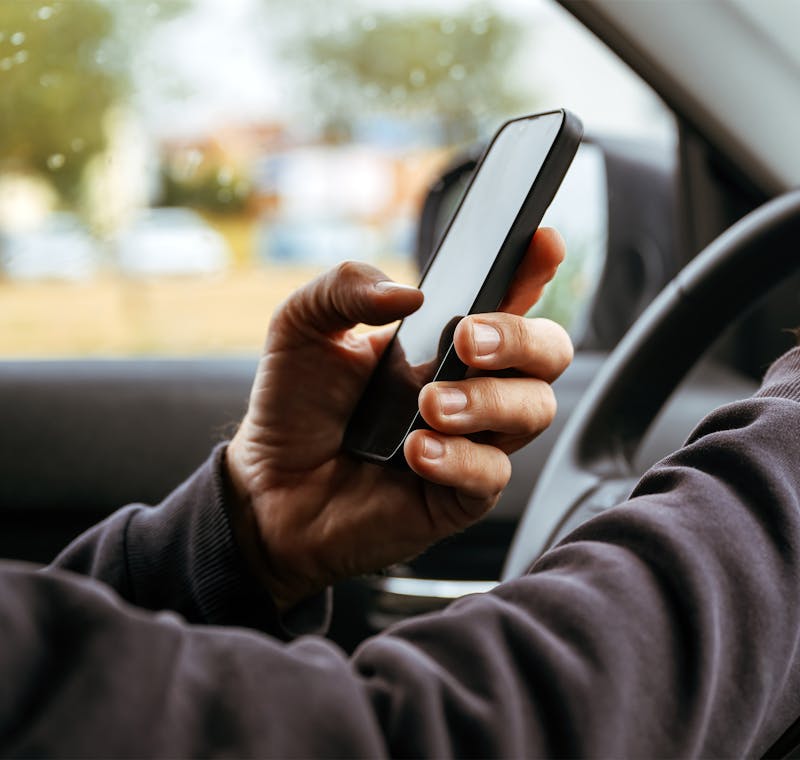
Proving that a driver was on their phone at the moment of a collision is one of the most consequential questions in a distracted driving case, and the answer hinges on a layered investigation that combines physical evidence, digital records, and forensic analysis.
Police and personal injury attorneys do not rely on a single piece of evidence; instead, they build a picture using cell phone records, surveillance footage, witness statements, and crash reconstruction to establish what the at-fault driver was doing in the seconds before impact.
At Cogburn Davidson Car Accident & Personal Injury Lawyers in Las Vegas, Jamie Cogburn and Hunter Davidson have spent nearly two decades holding distracted drivers and their insurers accountable for the devastation they cause. Jamie Cogburn is one of only 19 attorneys in Nevada certified in personal injury, and the firm has recovered more than $250 million for injured clients throughout Las Vegas and Henderson, including multiple multimillion-dollar car-accident verdicts.
If a distracted driver caused your crash, this guide explains exactly how that phone use gets proven, and how Cogburn Davidson uses that evidence to fight for full compensation.
What Nevada Law Says About Texting While Driving
Texting while driving is a primary offense in Nevada, meaning law enforcement can pull a driver over for phone use alone without any other traffic violation. Under Nevada Revised Statutes Section 484B.165, it is unlawful for a driver to manually use a handheld wireless communication device to compose, send, or read text messages, emails, or other written content while operating a motor vehicle on a public road.
The prohibition extends beyond simple texting. Drivers cannot manually dial a phone number, scroll through social media, or use any application that requires them to hold and interact with their device. Hands-free use is permitted; handheld use is not.
Key definitions under Nevada law include the following:
- Handheld wireless communication device: A cellular phone or similar device designed to transmit or receive voice or data communication.
- Manual use: Any physical interaction with the device that requires holding it in one or both hands.
- Primary offense: A violation for which an officer may stop a vehicle without observing any separate traffic infraction.
Violations carry escalating fines for repeat offenses, and when a crash results, a citation for handheld device use creates a formal record of negligence that carries significant weight in civil litigation.
How Police Investigate Distracted Driving at the Crash Scene
Law enforcement begins building a distracted driving case from the moment officers arrive. The scene itself often contains clues before any records are ever requested. Here is how a standard investigation unfolds, step by step:
Step 1: Secure the scene and observe the vehicles
- Officers photograph vehicle positions, point of impact, skid marks (or the absence of them), and sight lines
- A rear-end collision with no braking evidence, for example, is consistent with a driver who never looked up from a screen
Step 2: Interview drivers, passengers, and bystanders
- Officers take statements from everyone present
- A driver who admits to "just glancing" at a phone, or a witness who watched the at-fault driver looking down before impact, creates contemporaneous documentation that is difficult to retract later
Step 3: Check for visible phone activity
- Officers note whether a phone is in plain sight, whether the screen is illuminated, and whether the device is warm or recently active
- Dashboards, center consoles, and open laps are all examined
Step 4: Document the accident report
- The official collision report records any observed indicators of distraction
- Officers may note "driver inattention" or "cellular device use" in the contributing factors section, which becomes a foundational document for both criminal prosecution and civil litigation
Step 5: Apply for a search warrant for cell phone records
- When evidence suggests phone use contributed to the crash, investigators submit a probable cause affidavit to a judge for a warrant authorizing the phone carrier to produce records
- Following the U.S. Supreme Court's 2018 decision in Carpenter v. United States, law enforcement generally must obtain a warrant before accessing historical cell phone location data
Step 6: Submit records to a crash reconstruction expert
- In serious injury or fatality cases, a forensic analyst maps the timeline of phone activity against the collision time established by vehicle data recorders (EDR or "black boxes"), traffic signal logs, and surveillance timestamps
- A text sent 11 seconds before impact places the phone in the driver's hand at the critical moment
Step 7: Refer findings to the prosecutor or close with a citation
- Depending on the severity of the crash, investigators forward their findings to the district attorney for possible criminal charges
- They may issue a citation for the handheld device violation on the traffic report
How Cell Phone Records Prove Texting at the Time of a Crash
Cell phone records are among the most powerful and precise tools available in a distracted driving investigation. Carriers do not retain the content of text messages, but they do retain metadata, and metadata is what matters in court.
What phone records show:
- The exact date, time, and duration of outgoing and incoming calls
- Timestamps of text messages sent and received, accurate to the second
- Data session activity, including app usage and data transmissions
- Cell tower connection logs, which establish the geographic location of the phone during each activity
When a text message timestamp matches the collision time established by other evidence, the phone record creates a direct evidentiary link between the driver's device activity and the crash. Carriers such as AT&T, Verizon, and T-Mobile retain this metadata for varying periods, typically 12 to 24 months, which is why the timing of a records request matters enormously.
Types of Evidence Used to Prove Texting While Driving
No single piece of evidence proves distraction on its own. Investigators and attorneys combine multiple sources, each playing a different role in establishing what happened.
| Evidence Type | What It Establishes | How It Is Obtained | Key Limitations |
| Cell phone records | Timestamps of texts, calls, and data activity | Law enforcement warrant; civil subpoena | Content of messages not retained; carrier retention periods vary |
| Vehicle event data recorded (EDR) | Speed, braking, and steering input in the seconds before impact | Crash reconstruction; court order | Not all vehicles are equipped; data may be overwritten |
| Surveillance video | Visual confirmation of phone in hand | Public records request; civil subpoena to businesses | Coverage gaps; footage often overwritten within days |
| Witness testimony | Observed driver behavior before impact | Statements at the scene; deposition | Subject to memory limitations and credibility challenges |
| Social media activity | Posts, stories, or check-ins timestamped near crash time | Subpoena to the platform; public profile review | Difficult to prove the driver personally posted while driving |
| Crash reconstruction analysis | Speed, reaction time, and point of impact timeline | Retained expert | Required specialized expertise, and can be contested |
| Driver admission | Direct acknowledgment of phone use | Police report; record statements | Rare; most drivers deny phone use at the scene |
How Video Evidence Documents a Texting Driver
Surveillance and dashcam footage is often the most persuasive evidence available because it shows the jury exactly what happened rather than asking them to infer it. Multiple camera sources may capture the same crash or the moments leading up to it.
| Video Source | Typical Coverage | Retention Window | Who Requests It |
| Traffic signal cameras | Intersections, major arterials | 30 to 72 hours (varies by agency) | Police via public records; attorney via preservation letter |
| Business security cameras | Storefronts, parking lots, drive-throughs | 7 to 30 days typically | Attorney via preservation letter and subpoena |
| Casino and hotel cameras | Las Vegas Strip and surrounding corridors | Varies; casinos often retain longer | Attorney via subpoena |
| Dashcam footage (other vehicles) | Vehicles behind or adjacent to the crash | Depends on driver download; can be overwritten | Collected at the scene by the police or an attorney |
| Ring and residential cameras | Residential streets; neighborhood intersections | Typically, 30 to 60 days via cloud storage | Requested by the attorney directly from the homeowner |
| Body-worn camera (officer) | Scene arrival and interviews | Varies by agency policy; often 90 to 180 days | Public records request |
Preservation is time-sensitive. Many systems overwrite footage automatically. One of the first actions Cogburn Davidson takes after being retained in a distracted driving case is to send litigation hold letters to every business, municipality, and individual whose cameras may have captured the crash or the seconds before it.
What Happens After the Investigation: Criminal Charges vs. Civil Claims
The distracted driving investigation feeds into two separate legal tracks that run in parallel.
The prosecutor handles the criminal track after a citation for a handheld device results in a fine. In crashes causing serious injury or death, a driver may face reckless driving, vehicular manslaughter, or DUI charges if other substances are also involved. A criminal conviction or guilty plea creates an admission of fault that can be used in the civil case.
The civil track is where injured victims and their families recover compensation. In Nevada civil litigation, the standard of proof is a preponderance of the evidence, meaning it is more likely than not that the driver was texting. That lower threshold makes it possible to win a civil case even when the criminal standard of proof was not met, or when criminal charges were not filed at all.
A citation or criminal conviction for handheld device use does not automatically determine the outcome of a civil case, but it substantially strengthens it.
How Cogburn Davidson Builds a Texting-While-Driving Case in Nevada
When Cogburn Davidson takes on a distracted driving case, the firm follows a structured evidence-gathering process designed to preserve what deteriorates fastest and document what insurers will challenge most vigorously.
Here’s what that looks like:
- Immediate scene preservation: The firm sends a spoliation letter to all parties, including the at-fault driver, their insurer, and relevant businesses, demanding that all evidence be preserved pending litigation.
- Police report and body camera acquisition: The team obtains the collision report, the officer's body-cam footage, and any citations issued at the scene.
- Litigation hold to cell carriers: The firm serves a hold notice on the at-fault driver's carrier before records are overwritten.
- Subpoena for phone records: A formal subpoena duces tecum is issued to the carrier for call logs, text metadata, and data session records covering the period before, during, and after the crash.
- Surveillance footage requests: Preservation letters go out within 24 to 72 hours to every business, casino, municipality, or residential camera that may have captured relevant footage.
- Vehicle data recorder retrieval: If the at-fault vehicle's EDR contains pre-crash data, the firm moves to preserve and download it before the vehicle is repaired or totaled out.
- Expert engagement: An accident reconstruction specialist is retained to correlate phone record timestamps with EDR data, traffic signal logs, and the collision timeline.
- Driver deposition: The at-fault driver is deposed under oath regarding their phone use, driving history, and any prior distracted-driving incidents.
- Demand and litigation: The firm presents a comprehensive demand package to the insurer, backed by the full evidence record. If the insurer refuses to offer fair value, Cogburn Davidson files suit and prepares for trial.
What Distracted Driving Cases Are Worth in Nevada
According to the National Highway Traffic Safety Administration, distracted driving claimed 3,308 lives across the United States in 2022, and tens of thousands more victims sustained serious injuries. In Nevada, these cases routinely produce significant compensation when the evidence clearly establishes phone use.
Cogburn Davidson has recovered millions of dollars for car accident victims in Las Vegas and Henderson, including a $6.8 million car accident settlement, a $3.7 million car accident result, and multiple additional recoveries in the $2 million range. Distracted driving cases in which cell phone records corroborate the timeline often yield stronger outcomes because the evidence removes the central factual dispute and forces insurers to negotiate damages rather than liability.
Compensation in these cases typically covers:
- All medical expenses, including emergency care, surgeries, hospitalization, and future treatment
- Lost wages and diminished earning capacity
- Property damage
- Pain and suffering
- Emotional distress and loss of enjoyment of life
- Wrongful death damages, where applicable
Frequently Asked Questions About Texting-While-Driving Crash Claims in Nevada
What if the driver denies texting?
Denial is common and expected. Phone records do not require the driver's cooperation. A subpoena goes directly to the carrier, and the timestamps it produces are independent of anything the driver says. Denying phone use at the scene while records confirm a text was sent at the moment of impact is a credibility problem the at-fault driver carries into court.
Can phone records show the exact second a text was sent?
Yes. Carrier records reflect second-level timestamps for text message metadata. When that timestamp is matched against the collision time established by EDR data, traffic signal logs, or surveillance footage, the evidence becomes highly specific.
What if the driver deleted their texts before anyone requested them?
Deletion from the driver's device does not erase carrier records. Metadata is stored at the network level, not on the phone itself. Attempting to destroy evidence after a crash may also constitute spoliation, which carries its own legal consequences and can result in negative inferences being drawn against the driver at trial.
Does it matter if the driver was using an app instead of texting?
Yes, it still matters. Nevada's handheld device law prohibits manual use of a device for any purpose while driving, not just texting. Using a navigation app, scrolling social media, or interacting with any application while holding the phone is a violation of NRS 484B.165. Data session records from the carrier can show app activity, and social media platforms can be subpoenaed for timestamped posts and interaction data.
How long does it take to get cell phone records in a civil case?
Once a subpoena is served on a carrier, the response timeline varies but often ranges from four to eight weeks. Carriers have legal compliance departments that process subpoenas in order of receipt, which is one reason preservation requests should be made as early as possible to prevent overwriting before a subpoena is issued.
What if there are no cameras or witnesses?
Even without video or eyewitness testimony, phone records alone can be compelling when the timestamp aligns with the time of the collision. Crash reconstruction experts can independently establish the timeline from physical evidence, and a text message sent in the final seconds before impact may stand on its own when paired with an analysis showing the driver made no evasive maneuver.
Will a citation against the at-fault driver help my civil case?
A citation for handheld device use constitutes evidence of a traffic law violation and supports a finding of negligence per se in Nevada. Under the negligence per se doctrine, violating a statute designed to protect the public from a specific type of harm, such as distracted driving, can establish the breach-of-duty element of a negligence claim without requiring the plaintiff to prove what a "reasonable driver" would have done.
Contact Cogburn Davidson After a Distracted Driving Crash in Las Vegas or Henderson
If a texting driver caused your crash, the evidence that proves it is deteriorating right now. Surveillance footage overwrites. Carrier records have retention limits. The sooner your attorney acts to preserve and demand those records, the stronger your case will be.
The attorneys at Cogburn Davidson Car Accident & Personal Injury Lawyers move fast because they know what is at stake. Jamie Cogburn, one of only 19 attorneys in Nevada certified in personal injury, and Hunter Davidson, a trial attorney who has taken motor vehicle cases to jury verdicts, will personally evaluate your case and pursue every avenue of evidence available.
There is no fee to consult, and no attorney fees are owed unless Cogburn Davidson recovers compensation for you.
Call (702) 805-0652 or visit cdinjury.com to schedule a free case evaluation at the Las Vegas or Henderson office.
Disclaimer: The information on this page is provided for general educational purposes only and does not constitute legal advice. Every case is different. Past results do not guarantee future outcomes.