

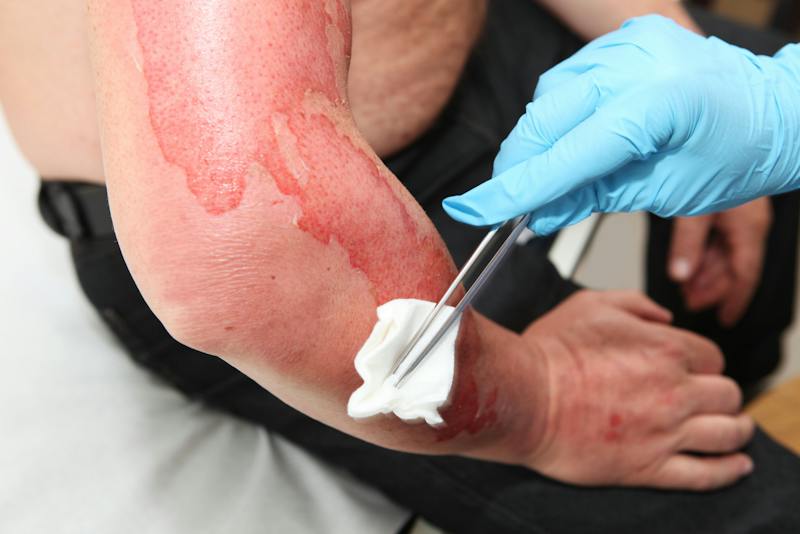
Summer pavement in Las Vegas can climb hot enough to cause a third-degree burn within minutes of skin contact, and property owners can be held liable when a hazardous surface condition on their property injures someone. Cogburn Davidson Car Accident & Personal Injury Lawyers holds a 4.9-star rating based on more than 500 client reviews and serves clients from offices in Las Vegas and Henderson, with 24/7 availability. This guide explains how premises liability law applies when extreme heat, rather than a wet floor or broken stair, is the hazard.
What Are Pavement Burns, and How Severe Can They Get?
Pavement burns happen when skin stays in contact with superheated asphalt, concrete, or metal surfaces long enough to cause a thermal injury.
A peer-reviewed study found that asphalt temperatures in Las Vegas can climb as high as 166 degrees Fahrenheit during the summer months, well above the roughly 111-degree surface threshold at which pavement burn injuries begin.
At Las Vegas's Lions Burn Care Center, staff reportedly treat pavement burns as roughly 13 percent of all serious burn injuries seen at the facility, a share the center's medical director has called significant.
These injuries can be deceptive. What looks like a sunburn at first can progress over several days into a third-degree or even fourth-degree burn that reaches muscle or bone, since pavement retains heat longer than an open flame, and victims often remain in contact with it longer than they realize.
Several groups face heightened risk of these injuries, including:
- Young children walking barefoot on hot sidewalks or playground surfaces
- Adults who collapse from heat stroke, dehydration, or intoxication and are unable to get up
- Older adults who fall due to a medical event and cannot quickly remove themselves from the surface
Who Is Liable for a Heat-Related Pavement Burn Injury in Las Vegas?
Nevada premises liability claims are grounded in ordinary negligence under NRS 41.130, and the duty a property owner owes depends on the visitor's legal status.
Nevada common law recognizes three categories of visitors, each owed a different level of care:
- Invitees, such as hotel guests, casino patrons, and customers, are owed the highest duty of care, including a duty to inspect for hazards and fix or warn of them
- Licensees, such as social guests, are owed a duty to warn of known hazards that aren't obvious
- Trespassers are generally owed only a duty not to be intentionally or recklessly harmed
A key rule from the Nevada Supreme Court applies directly to pavement burn claims. In Foster v. Costco Wholesale Corp., the court held that an open and obvious hazard does not automatically eliminate a property owner's duty of care.
The court reasoned that a jury must still weigh whether the property owner breached its duty by allowing the dangerous condition to exist, even if the hazard was visible. That reasoning matters here because hot pavement, unlike a hidden defect, is often plainly visible, yet the danger it poses may not be.
Is Extreme Heat a Recognized Premises Liability Hazard Under Nevada Law?
No Nevada appellate decision has yet addressed extreme surface heat as a distinct hazard category, as courts have addressed slip-and-fall or negligent security claims. That said, the foreseeability principle that runs through Nevada premises liability law, reinforced by Foster, does not require a hazard to have its own named legal category before a property owner can be held responsible for it.
Given the well-documented research on Las Vegas pavement temperatures and the volume of pavement burn patients treated each summer locally, a property owner in a market like Las Vegas arguably has reason to know that certain areas can become dangerously hot, including:
- Unshaded pedestrian walkways and sidewalks
- Pool decks and surrounding surfaces
- Valet areas and other unshaded stretches of pavement
Whether that translates into a viable claim depends heavily on the specific facts, including what precautions, if any, the property took, such as shade structures, misting systems, or posted warnings. Because this is a developing area, every case needs to be evaluated on its own facts rather than assumed to fit a general rule.
What Should You Do If You Suffer a Pavement Burn?
A suspected third-degree pavement burn is a medical emergency and needs immediate professional treatment, not home remedies. Beyond seeking care, a few steps can help preserve a potential claim:
- Get emergency medical treatment right away, since pavement burns can worsen significantly over the following days
- Photograph the surface where the injury occurred, along with the surrounding area and any shade or warning signage
- Note the approximate time of day and weather conditions, since pavement temperature swings dramatically with direct sunlight
- Get contact information from any witnesses
- Keep all medical records and follow-up treatment documentation
Can You Sue a Property Owner, Resort, or Event Organizer Over a Heat Injury?
Yes, if the property owner, resort operator, or event organizer failed to take reasonable precautions against a foreseeable pavement heat hazard.
Depending on where the injury occurred, potentially responsible parties include:
- A resort or casino, where pool decks, valet areas, and outdoor walkways see extraordinarily high foot traffic
- An event organizer hosting an outdoor festival, pool party, or convention on hot pavement
- A property management company responsible for maintaining common outdoor areas
- A business owner whose parking lot, entrance walkway, or patio contributed to the injury
Any of these parties can be held responsible if their own negligence, such as failing to provide shaded areas or adequate warnings, contributed to the injury. As with any premises liability claim, Nevada's modified comparative negligence rule may reduce or bar recovery if the injured person is found partly at fault, and claims generally must be filed within two years of the injury under NRS 11.190.
Catastrophic Burns Deserve Serious Legal Representation
Severe pavement burns can mean skin grafts, extended hospitalization, and lasting scarring, injuries that deserve the same level of attention as any other catastrophic case. Cogburn Davidson Car Accident & Personal Injury Lawyers has secured results, including a $6.8 million car accident recovery and a $4.2 million negligence settlement for clients across Southern Nevada. If extreme heat has left you or a loved one seriously burned, the firm's attorneys can help evaluate whether a property owner failed in its duty to keep you safe. Contact us today to book your case evaluation and learn more about your legal rights and options.
Disclaimer: The information on this page is provided for general educational purposes only and does not constitute legal advice. Every case is different. Past results do not guarantee future outcomes.
Sources